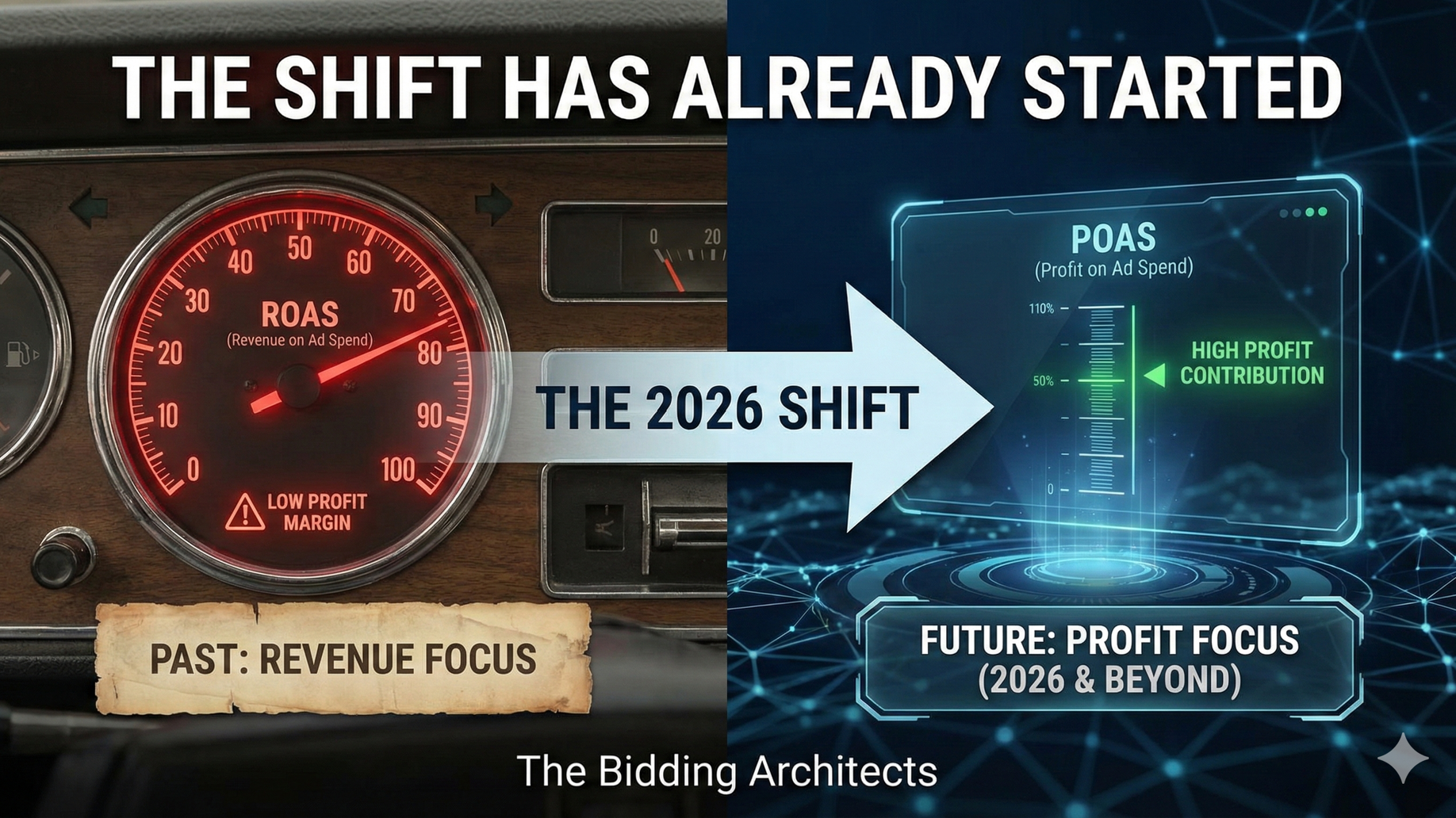
The Shift Has Already Started
For years, ROAS has been the default performance metric in ecommerce advertising. It is simple, universal, and easy to benchmark. But simplicity is becoming a liability.
ROAS tells you how much revenue you generate per pound of ad spend. It says nothing about whether that revenue was profitable. And in 2026, that distinction will separate brands that scale from brands that stall.
Why ROAS Is Losing Its Edge
ROAS worked when margins were consistent and competition was predictable. Neither is true anymore.
Consider this: a 400% ROAS on a product with 25% margin generates a different outcome than a 400% ROAS on a product with 55% margin. The first barely breaks even. The second funds growth.
Yet most Google Ads accounts treat both scenarios identically. The algorithm optimises for revenue, not profit. It will happily spend your budget on low-margin products if they convert well.
This is not a bug. It is how the system was designed. The question is whether you continue to accept it.
What POAS Actually Measures
POAS, or Profit on Ad Spend, shifts the optimisation target from revenue to contribution margin. Instead of asking "how much did we sell?", it asks "how much did we keep?"
The difference sounds academic until you run the numbers. Brands optimising for POAS consistently find that their most profitable products are not their highest-revenue products. They discover that scaling certain campaigns actually reduces total profit.
This is information ROAS cannot provide.
The Implementation Gap
Moving to POAS requires more than a mindset shift. It requires:
- Accurate margin data at the SKU level, updated as costs change
- Feed integration that passes profit signals to Google
- Bidding logic that prioritises margin, not just conversion value
- Reporting frameworks that surface profit, not just revenue
Most agencies cannot deliver this because they are structured around ROAS reporting. Their dashboards, their benchmarks, their client conversations all revolve around a metric that is increasingly disconnected from commercial reality.
Who Benefits Most
POAS is not universally better. It matters most for:
- Multi-SKU retailers with significant margin variation across products
- Brands with rising input costs where yesterday's margins no longer apply
- Accounts spending £15k+/month where the difference between revenue and profit compounds quickly
- Businesses with cash flow constraints where every pound of waste has a cost
If your margins are consistent across products and your costs are stable, ROAS may still serve you well. But that describes fewer brands each year.
The 2026 Inflection Point
Why 2026? Because the tools are finally catching up to the strategy.
Google's profit bidding signals are maturing. Feed management platforms now support margin data at scale. The infrastructure exists, but adoption lags.
Brands that implement POAS now will spend the next 12 months refining their approach while competitors are still debating whether to start. That gap compounds.
What This Means For Your Account
If you are still optimising purely for ROAS, you are optimising for a proxy. The question is whether that proxy still correlates with what you actually care about.
For most ecommerce brands above £10k/month in ad spend, the answer is increasingly no.
We help brands transition from revenue-focused to profit-focused Google Ads management, including the feed work, bidding logic, and reporting frameworks required to make POAS operational.
If you want to understand what POAS would look like for your account, book a discovery call and we will walk through the numbers together.